Apartment gate security entry management combines access control hardware (e.g. key cards, mobile credentials, keypads, and intercoms) with cloud-based management software to verify entry, restrict unauthorized access, and log every attempt. The strongest systems pair credential-based access with video verification and integration into property management software.
Apartment communities rely on predictable, well-managed entry systems to maintain a safe and organized environment. The gate is often the first, and sometimes the only, control point between public space and private residential areas.
When the system works consistently, residents experience smooth arrivals, fewer delays, and a greater sense of safety. When it fails, everything slows down: long wait times, frustrated residents, unauthorized entry issues, and complicated manual workarounds.
Infassure has designed and installed access control and security systems since 1985, with offices serving Dallas-Fort Worth and Houston and project teams that work nationwide. This guide covers how modern apartment gate security works, the components that matter, what it costs, and the best practices that keep a gate running the way residents expect.
Ready to upgrade your community’s gate access? Speak with an Infassure team member today.
Key takeaways
- Apartment gate security entry management combines credentials, readers, a control panel, and management software to decide who gets in and record every attempt.
- Mobile credentials and cloud management have replaced shared gate codes as the standard for new and upgraded communities.
- Most gate problems are policy problems, not hardware problems: shared codes, stale resident lists, and no plan for lost fobs.
- A video intercom or telephone entry system handles guests and deliveries without giving out codes.
- Tailgating is the most common failure at apartment gates, and it’s addressed with camera placement, operator timing, and analytics, not more hardware.
What Is Apartment Gate Security Entry Management?
Apartment gate security is the combination of hardware and software that verifies who enters a residential community and creates a record of that activity. Gate access control manages the movement of residents, guests, service providers, and deliveries, creating a structured and predictable perimeter.
A well-designed gate security system verifies credentials, logs activity, and ensures that only authorized individuals can enter the property. These capabilities reduce risk, protect residents, and support daily operations in a community where entry is constant and continuous.
Benefits of Gate Entry Management for Apartment Gates
Effective gate entry management improves more than perimeter security. It impacts resident satisfaction, operational efficiency, and overall property performance.
Stronger Protection Against Unauthorized Entry
Traditional keys and standalone gate codes create vulnerabilities. Keys can be copied. Codes can be shared or forgotten. Modern keypad entry systems verify credentials in real time and restrict access immediately when a user is removed from the system. This is especially essential when a property does not have a team of 24-7 security personnel.
Clear Visibility Into Activity
Every entry attempt is logged, successful or failed, which allows property managers and building owners to:
- Review incidents
- Identify patterns
- Detect unusual behavior
- Strengthen security protocols
Instead of guessing what occurred, managers and security staff have reliable data to guide decisions.
Better Convenience for Residents
Mobile credentials, fobs, cards, and PIN codes reduce delays and provide flexible access options. When residents can enter smoothly, especially during peak hours, overall satisfaction improves.
Automated processes also reduce the stop-and-start delays common in older gate systems. When movement is predictable, both residents and visitors experience smoother entry.
More Efficient Property Operations
Remote management tools let staff assist guests, service providers, and deliveries without leaving the office. Cloud platforms allow updates, access permissions changes, and troubleshooting from any connected device.
Types of Apartment Gate Security Systems
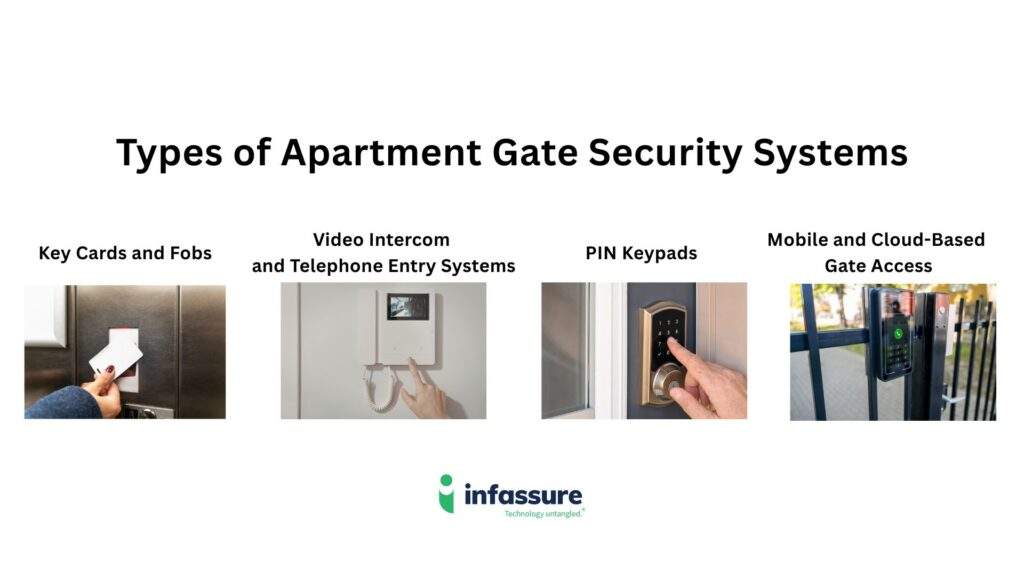
There are different access control and entry management methods that can be used at apartment gates. Most communities combine several of these to match resident expectations, security goals, and budget.
1. Key Cards and Fobs
Key cards and fobs are still one of the most common solutions. Residents present a programmed credential at a reader near the gate; if permissions are valid, the gate operator activates and allows entry.
Lost cards can be deactivated and replaced without rekeying hardware, which is a major improvement over traditional keys. These systems are straightforward, familiar to most residents, and work well in communities with high vehicle traffic.
Pros: familiar, fast at vehicle gates, lost cards deactivate instantly.
Cons: physical item to issue and collect; older 125 kHz prox cards can be cloned.
2. Mobile and Cloud-Based Gate Access
Mobile access uses smartphones as the primary credential. Residents tap or present their phone at the reader, or use an app to open the gate from a short distance.
Cloud management platforms back these systems, so permissions and logs are stored centrally and can be updated remotely. This model reduces the number of physical credentials in circulation and allows property teams to manage access from any connected device.
Pros: can’t be copied, revoked instantly, visitors get virtual passes, managed from anywhere.
Cons: requires a smartphone; usually a monthly platform fee.
3. PIN Keypads
PIN keypads require users to enter a numeric code to open the gate. They are cost-effective and easy to install, which is why many properties start here. Security, however, depends heavily on how codes are managed. Shared or rarely changed codes become less effective over time.
Best practice is to use unique codes for residents or short-term codes for visitors, with regular updates to keep security controls meaningful.
Pros: lowest cost, nothing to carry.
Cons: shared codes spread; no record of who entered unless codes are unique.
4. Video Intercom and Telephone Entry Systems
Video intercoms and telephone entry systems provide controlled guest access. Visitors scroll a directory or enter an apartment number, then call the resident or office. The resident can speak with the visitor (and with video intercoms, see them) before pressing a button to open the gate remotely.
These systems work well in urban properties or communities with frequent deliveries, rideshare traffic, and short-term guests.
Pros: visual verification of guests, remote release, handles deliveries.
Cons: depends on the resident answering; older callboxes on retired cellular networks stop working.
5. License Plate Recognition and Vehicle Tags
For vehicle gates, two options remove the need to stop and present a credential. Windshield RFID tags are read by a long-range reader as the car approaches. License plate recognition (LPR) cameras read the plate itself and match it against the resident list.
Both work well for resident lanes with steady traffic. Tags are cheaper per vehicle and very reliable. LPR needs no tag at all and creates an image record of every vehicle, which helps with incident review. Unfortunately, it can misread plates in heavy rain or poor lighting. Most communities pair either option with a reader or keypad as a backup and keep a separate visitor lane with an intercom.
Pros: hands-free, image record of every vehicle.
Cons: LPR misreads in bad weather or lighting; needs a backup credential.
Guard-staffed gates give direct human oversight but cost the most to run and slow entry at peak hours; most communities that have a guard also run one of the systems above. Biometric readers (fingerprint or face) are secure but expensive, raise privacy questions with residents, and are rare at apartment gates outside of high-end properties. We don’t recommend either as a primary system for most communities.
Components of Apartment Gate Security
A dependable gate security system combines several coordinated technologies that support daily movement throughout an apartment complex. These components help a property manager evaluate new proposals, solve operational issues, and plan long-term upgrades.
Access Control Panel & Management Software
The gate access control system is the system’s central processor. It decides whether to grant or deny entry based on the credential presented. Management software supports everyday tasks such as:
- Updating resident permissions
- Reviewing activity logs
- Generating reports
- Troubleshooting issues
Cloud-based apartment gate security solutions also allow staff to make changes remotely, which reduces delays and improves responsiveness during peak traffic periods.
Readers, Keypads, and Intercom Stations
These devices shape the user’s experience at the gate. Card readers, fob readers, and mobile credential readers support secure residential gate access control.
Mobile credential readers allow residents to open the gate using their phone, supporting hands-free access. Keypads still play a role in many communities but require strict code-management policies.
Similarly, an intercom system adds a structured layer of visitor management, allowing residents or staff to visually or verbally verify a guest before opening the gate.
Gate Operators and Physical Mechanisms
The operator is the mechanical engine behind the gate. Slide, swing, and barrier-arm operators must be sized correctly for the gate’s weight, traffic level, and frequency of use.
Poorly sized or aging operators lead to slow response times, resident complaints, and increased maintenance downtime. Safety sensors, vehicle loops, and obstruction detection ensure that the gate operates safely while maintaining the security measure of the perimeter.
Surveillance Cameras and Monitoring Points
Security cameras positioned at the entry provide visual context that supports both real-time decision-making and incident investigation. When integrated with the gate access control system, cameras can automatically bookmark footage of specific access events.
This helps staff to confirm identities, investigate tailgating, or resolve disputes more efficiently. High-resolution video is especially valuable in communities with heavy visitor or delivery traffic.
Credentials and Access Policies
The credential, whether a mobile device, fob, card, PIN, or license plate, determines who can enter and when. But equally important are the policies that guide how those credentials are issued, managed, and revoked. A strong policy ensures:
- Lost or unreturned credentials are disabled immediately
- Shared PIN codes are avoided or regularly updated
- Resident databases remain accurate and up-to-date
Without clear credential policies, even the best technology becomes less effective.
Integration with Other Building Management Systems
Gate systems reach their full potential when they operate as part of a broader property ecosystem. Integration strengthens both security and convenience across the apartment building.
Property Management Platforms
When access control syncs with resident databases, move-ins and move-outs become seamless. As soon as a resident’s status changes, their gate permissions update automatically. This reduces manual errors and ensures no outdated credentials remain active.
Video Surveillance and Intrusion Systems
Gate activity is often the starting point of an incident timeline. Integrating surveillance with access control allows the property team to:
- Pull up video clips associated with specific gate events
- Verify the identity of residents, guests, or vehicles
- Detect forced entry or tailgating behaviors
This unified record of video and access data creates clearer incident documentation.
Emergency and Life-Safety Systems
During emergencies, gate systems must accommodate fire, police, and medical access. Integrated systems can automatically override normal restrictions and open designated gates when a fire alarm or emergency signal is activated. This ensures safety protocols function smoothly without requiring manual intervention.
What to Look for in an Apartment Gate Entry System
Whatever system type you choose, these are the features that separate a gate that works for ten years from one that becomes a daily complaint:
- More than one credential type. Cards or fobs plus mobile, so residents who don’t want an app still have an option.
- Per-resident credentials and logs. Every entry tied to a unit, with a searchable history.
- Visitor passes that expire. One-time codes, scheduled virtual keys, or intercom release.
- Property management integration. Move-outs deactivate access without anyone touching a spreadsheet.
- Cloud management with a mobile app. Staff can open the gate, add a vendor, or pull a log from anywhere.
- Camera integration. Video clips attach to access events.
- Battery backup and a fail plan. Know what the gate does when power or network drops.
- Current cellular hardware. Any callbox or cloud controller should be on a supported network, not a retired one.
- Emergency access. Knox box, siren sensor, or fire alarm override coordinated with the local fire marshal.
- Local support. Gates break. A provider who can be on site matters more than a slick app.
Security Considerations in Apartment Access Control
Stronger hardware alone does not guarantee enhanced security. Even the most advanced residential gate access control solution requires thoughtful planning and ongoing oversight.
Data Protection and Privacy
Access control systems store sensitive information such as resident credentials and activity logs. Systems should support encrypted communication, role-based administrative access, and transparent data policies that protect both residents and the community.
Tailgating Prevention and Perimeter Integrity
Even with strong access controls, vehicles or pedestrians can sometimes slip in behind an authorized user. Strategic camera placement, signage, and operator timing help reduce this risk. Software analytics can also detect unusual movement patterns or repeated tailgating attempts.
Maintenance, Monitoring, and Long-Term Support
A well-designed system still requires maintenance. Regular inspections, hardware calibration, and software updates prevent unexpected failures and extend the life of the equipment. Many communities benefit from remote monitoring tools that alert staff to equipment issues before residents experience delays at the gate.
Apartment Gate Security Best Practices
Most gate failures come down to process, not hardware. These are the practices we recommend to every community we work with:
- Give every resident a unique credential. No shared gate codes. If you use a keypad, each unit gets its own code and it changes at move-out.
- Tie the access list to your property management software. Move-outs should deactivate credentials automatically. Manual lists drift within weeks.
- Use expiring visitor access. One-time codes, virtual passes, or intercom release. A permanent “guest code” is a shared code with a nicer name.
- Put a camera on every lane. Facing the driver, angled to catch the plate, integrated so the clip attaches to the access event.
- Set operator timing for one vehicle. A gate that stays open long enough for two cars invites tailgating. Adjust the close delay and add a vehicle loop if needed.
- Post clear signage. “One vehicle per cycle” and “No tailgating” signs reduce disputes and give staff something to point to.
- Have a lost-credential process. Residents should be able to report a lost fob or phone and have it disabled the same day, without a visit to the office.
- Plan for emergency access. Fire, police, and EMS need a way in. Knox box, siren-activated opener, or a fire alarm override, coordinated with your local fire marshal.
- Schedule maintenance. Operators, loops, and safety sensors need inspection at least twice a year. A stuck-open gate is the most common way a “secure” community becomes an open one.
- Keep the callbox current. Older telephone entry systems that ran on 3G cellular stopped working when carriers shut those networks down. If your callbox is more than a few years old, check that it’s on a supported network.
Common Apartment Gate Problems and How to Fix Them
| Problem | Usual cause | Fix |
|---|---|---|
| Gate stuck open | Failed operator, tripped safety sensor, or staff propped it open after complaints | Service the operator; adjust sensors; address the complaint that caused the prop |
| Residents tailgating in behind each other | Close delay too long, no camera, no consequences | Shorten close delay, add vehicle loop, camera on the lane, signage |
| Everyone knows the gate code | Shared code never rotated | Move to unique credentials; if keypad stays, per-unit codes with rotation |
| Delivery drivers can’t get in | No visitor lane or intercom, or callbox is offline | Video intercom with directory; temporary delivery codes; check callbox network |
| Former residents still have access | Manual credential list not updated at move-out | Integrate with property management software; audit the list quarterly |
| Long lines at peak hours | Slow reader, slow operator, or one lane for residents and visitors | Long-range tags or LPR for residents; separate visitor lane |
| Fob works at some gates but not others | Multiple standalone systems that were never unified | Consolidate onto one platform with one credential |
What Apartment Gate Security Costs
Cost depends on the number of gates and lanes, the credential type, whether cabling and power already reach the gate, and how much integration you want.
Ongoing costs include cloud platform subscriptions, cellular service for the callbox, and maintenance. A site walk is the only way to get an accurate number, since trenching for power and data is often the biggest variable. Questions? Let’s talk today.
Ready to Fix or Upgrade Your Gate?
Apartment gate security and entry management are central to creating a safe, predictable residential environment. Strong access control helps protect residents, streamlines daily operations, and supports the long-term performance of the property.
For communities evaluating upgrades or planning new construction, Infassure designs, installs, and supports gate access control, surveillance, intercoms, and the structured cabling behind them. Our Richardson office serves apartment communities across Dallas-Fort Worth, our Houston office serves the Greater Houston area, and we handle multi-property portfolios nationwide.
If your gate has recurring problems, or you’re planning a new community, request a quote or call (972) 680-7800 in North Texas or (281) 640-3326 in Houston. An Infassure team member will walk the property and give you a clear plan.
Apartment Gate Security FAQs
How much does an apartment gate security system cost?
A basic keypad and reader on an existing gate starts in the low thousands installed. A full system with video intercom, mobile credentials, cameras, and cloud management for one gate typically runs into the mid five figures, with more for additional lanes or trenching for power and data. A site walk is the only way to get an accurate number for your property.
Can residents open the gate from their phone?
Yes. Mobile credential systems let residents tap their phone at the reader or open the gate from an app. Most also let residents issue temporary passes to guests without calling the office.
How do I stop tailgating at an apartment gate?
Shorten the gate’s close delay so it cycles after one vehicle, add a vehicle detection loop, put a camera on the lane so incidents are recorded, and post signage. Analytics on newer camera systems can flag repeat tailgating so staff can follow up.
What happens to the gate during a power outage?
Gate operators usually have battery backup for a limited number of cycles. Beyond that, most communities set the gate to fail open so residents and emergency services aren’t locked out. Your installer configures this, and it should match local fire code.
Do apartment gate systems work with existing property management software?
Yes. Most modern gate access control systems can sync with property management platforms so resident permissions update automatically when someone moves in or out.
What’s the difference between a fob and a mobile credential?
A fob is a physical device presented at a reader. A mobile credential uses a resident’s smartphone, either tapped at the reader or triggered through an app. Mobile credentials can’t be copied, can be revoked instantly, and reduce the number of physical credentials in circulation.
Does Infassure install apartment gate systems outside of Texas?
Yes. Our offices are in Richardson and Houston, and we handle multi-property portfolios for owners with communities across the country.